Showing posts with label snack of the week. Show all posts

Monday, May 16, 2011

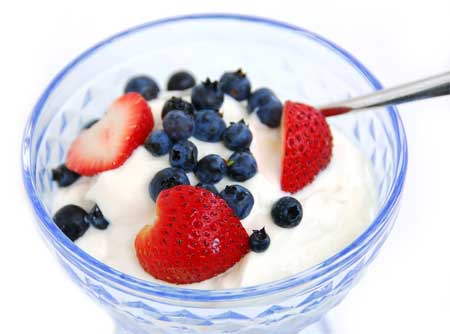
Snack of the Week - Yogurt


I'm posting some of my favorite healthy snacks that I eat.  I want to keep these snacks always fresh in your mind, so I'm going to post a new one every week.  Some of them will be foods that you have all the time, but never knew how beneficial they were.  Some of them will be foods you thought were gross, but maybe deserve a second chance.  Some of them may be foods you've never even heard of!  Whatever the case may be, if you're out at your local grocery, remember to pick up a little of one of these foods and chew on them for thought!

About Yogurt
Yoghurt, yogurt or yogourt (Turkish: yoğurt) is a dairy product produced by bacterial fermentation of milk. The bacteria used to make yoghurt are known as "yoghurt cultures". Fermentation of lactose by these bacteria produces lactic acid, which acts on milk protein to give yoghurt its texture and its characteristic tang.

Believe me that you really don't want to know much more than that if you have a weak stomach.  This food is delicious and nutritious.  Don't let the process of how it's made ruin your appetite for it!
(Source: Wikipedia.org)

Ways to Enjoy Yogurt
This is by-far one of my most favorite snacks.  It's cold, it's sweet, and it's tart all at the same time.  Yogurt comes in so many forms too.  You can get it in it's regular glory, low-fat, low-sugar, sugar free, Greek style, plain, with fruit, with candy, flavored, and frozen!  I personally like to just open up a container of low-fat vanilla flavored yogurt and dig in.

Yogurt is one of those foods that has to be kept in moderation though.  Most of them are high in carbohydrates, so they can easily be turned into fat.  However, they shouldn't be eliminated from your diet completely as the probiotics in them are great for your digestive tract!

Yogurt Nutrition
This time, I had to be specific about which yogurt I wanted nutrition data for.  I chose Low Fat Vanilla, as it is one of the most common kinds.


Monday, May 9, 2011

Snack of the Week - Jerky


I'm posting some of my favorite healthy snacks that I eat.  I want to keep these snacks always fresh in your mind, so I'm going to post a new one every week.  Some of them will be foods that you have all the time, but never knew how beneficial they were.  Some of them will be foods you thought were gross, but maybe deserve a second chance.  Some of them may be foods you've never even heard of!  Whatever the case may be, if you're out at your local grocery, remember to pick up a little of one of these foods and chew on them for thought!


About Jerky
Jerky is meat that has been cut into strips, trimmed of fat, marinated in a seasoned sweet rub or liquid, and dried or smoked with low heat (usually under 70 °C/160 °F) or is occasionally just salted and sun-dried. The result is a sweet (occasionally semisweet or savory) snack which can be eaten immediately, or which can be stored for months without refrigeration.

The word "jerky" comes from the Quechua term "charqui", which means to burn (meat).  Jerked meat was one of the first human-made products and was a crucially important food preservation technique for survival.
(Source Wikipedia.org)

Ways To Enjoy Jerky
Here lately, I've gotten the itch.  The itch that I'm talking about is for camping and hiking.  I love to go out into the wild and just walk about.  Spending time there is awesome, and one of the only ways to hinder that experience is to not have proper food there with you.  We all know how much of a bummer it can be to have to cut a camping or hiking trip short because you have to go somewhere to cook and prepare your food.  Jerky can be stored almost anywhere that is dry and doesn't need to be refrigerated.  You cook the jerky at home and bring it with you, so there is no need for further cooking.  It will keep for months without spoiling.  It is the perfect trail food.

You can eat jerky almost any way imaginable.  I prefer to pull out tiny slivers at a time and chew on them for a while like chewing gum.  The flavor will last for a really long time.  Although, there is nothing wrong with just munching away at it!  If you don't feel like eating the jerky by itself, you can always shred it up into a salad (with all these snacks going into salads lately, I must have the itch to eat one of those too...) or put it into a soup to add the the great flavor of the broth you're already working with.

Jerky is relatively simple to make, so if this recession and high gas prices have got you down, don't fret about paying big money for that bag from the grocery store.  All you need is some meat (cut into strips), some flavoring, and a method to dehydrate it.  Personally, I like to take some beef for making a pot roast, cut it into slivers, soak it in a marinade of Liquid Smoke, brown sugar, and soy sauce, and then cook it on a NuWave oven.  However, a regular oven or a dehydrator (duh!) work just as well.  Make sure to store it in a dry and airtight container when not being consumed.  Freezing or refrigerating will help in making it last longer until you use it.

How to make Beef Jerky at Wikihow.com
Alton Brown Beef Jerky Recipe  ( <<<  Delicious!!! )

Beef Jerky Nutrition


Monday, May 2, 2011

Snack of the Week - Celery


I'm posting some of my favorite healthy snacks that I eat.  I want to keep these snacks always fresh in your mind, so I'm going to post a new one every week.  Some of them will be foods that you have all the time, but never knew how beneficial they were.  Some of them will be foods you thought were gross, but maybe deserve a second chance.  Some of them may be foods you've never even heard of!  Whatever the case may be, if you're out at your local grocery, remember to pick up a little of one of these foods and chew on them for thought!

About Celery
Apium graveolens is a plant species in the family Apiaceae commonly known as celery or celeriac depending on whether the stalks or roots are eaten.
(Source: Wikipedia.org)

Ways to Enjoy Celery
This is another simple snack to eat!  But it, cut it up, wash it, and enjoy.  If you're not into eating this food by itself, enjoy it with a nut butter or some cream cheese.  Combine it with some peanut butter, and some of the raisins I told you about a few weeks ago to make Ants on a Log!

Like most of our other snacks, celery is great when cut up and put into a salad.  I also understand that celery can be cut up into slices for stir-frying and things like that, but it's never lasted long enough to make it that far in my home.


Celery Nutrition


Monday, April 18, 2011

Snack of the Week - Hard Boiled Eggs


I'm posting some of my favorite healthy snacks that I eat.  I want to keep these snacks always fresh in your mind, so I'm going to post a new one every week.  Some of them will be foods that you have all the time, but never knew how beneficial they were.  Some of them will be foods you thought were gross, but maybe deserve a second chance.  Some of them may be foods you've never even heard of!  Whatever the case may be, if you're out at your local grocery, remember to pick up a little of one of these foods and chew on them for thought!

About Hard Boiled Eggs
Boiled eggs are eggs (typically chickens' eggs) cooked by immersion in boiling water with their shells unbroken. (Eggs cooked in water without their shells are known as poached eggs, while eggs cooked below the boiling temperature, either with or without the shell, are known as coddled eggs.) Hard-boiled eggs are either boiled long enough for the egg white and then the egg yolk to solidify, or they are left in hot water to cool down, which will gradually solidify them, while a soft-boiled egg yolk, and sometimes even the white, remains at least partially liquid.
(Source: Wikipedia.org)

Ways to Enjoy Hard Boiled Eggs
I would say the most common way to enjoy this snack on this particular week will be to find the brightest colored one you can, pick it up off the ground, peel away the shell, and eat away!  However, if you find a shell made of plastic, give it to a kid.  You do not need this egg.

Honestly though, hard boiled eggs are pretty simple to enjoy.  After they're cooled down (unless you like them hot!), peel the shell and munch away.  I usually like to lightly sprinkle some sea salt on mine with every few bites.  This snack is very filling and is highly versatile!  You can take them and eat them almost anywhere, although I do caution that they sometimes give off an unpleasant odor before and - after - eating them.

If you don't like eating hard boiled eggs as they come, there are other ways to enjoy this tasty and healthy food!  You can always slice them up and enjoy them in your next salad.  Also, if you make more than one hard boiled egg, you can take the yolks out (leaving the white in-tact) and mix them with a little mayo and mustard and put them back in the whites for some Deviled Egg fun.

As far as getting hard boiled eggs goes, it's pretty easy.  If you have eggs at home, stick them in a pan on cold water (gently) and make sure the water level is above the eggs.  Put the pan on the stove and get the water to a rolling boil, then turn off the heat.  Let the eggs set in the water until it is cool, then enjoy after that or stick them in the fridge for later!  Also, if you're not in to making them yourself, several groceries and gas stations like Thorntons sell them, ready to eat.

Hard Boiled Egg Nutrition

Tuesday, April 12, 2011

Snack of the Week - Raisins


I'm posting some of my favorite healthy snacks that I eat.  I want to keep these snacks always fresh in your mind, so I'm going to post a new one every week.  Some of them will be foods that you have all the time, but never knew how beneficial they were.  Some of them will be foods you thought were gross, but maybe deserve a second chance.  Some of them may be foods you've never even heard of!  Whatever the case may be, if you're out at your local grocery, remember to pick up a little of one of these foods and chew on them for thought!

About Raisins
Raisins are dried grapes. They are produced in many regions of the world. Raisins may be eaten raw or used in cooking, baking and brewing. In the United Kingdom, Ireland, Australia, and New Zealand the word "raisin" is reserved for the dried large dark grape, with "sultana" being a dried large white grape, and "currant" being a dried small Black Corinth grape.
(Source: Wikipedia.org)

Ways to Enjoy Raisins
The first thing that needs to be said before you go and open up that box of raisins is this: Raisins are over 50% sugar, so they should be enjoyed in moderation.   Once again, my favorite way to enjoy this food is straight out of the box.

If you're looking for a little something extra, raisins can be added to those almonds I mentioned a couple of weeks ago with some other nuts and a little bit of dark chocolate to make a delicious trail mix.  Raisins also work great as a salad topper.  You can also throw them into a chicken salad, or get nostalgic using them to top some nut butter on a banana or celery to make Ants on a Log!

Raisin Nutrition

Monday, April 4, 2011

Snack of the Week - Canned Tuna


I'm posting some of my favorite healthy snacks that I eat.  I want to keep these snacks always fresh in your mind, so I'm going to post a new one every week.  Some of them will be foods that you have all the time, but never knew how beneficial they were.  Some of them will be foods you thought were gross, but maybe deserve a second chance.  Some of them may be foods you've never even heard of!  Whatever the case may be, if you're out at your local grocery, remember to pick up a little of one of these foods and chew on them for thought!

About Canned Tuna
Canned tuna was first produced in 1903, quickly becoming popular. Tuna is canned in edible oils, in brine, or spring water. In the United States, 52% of canned tuna is used for sandwiches; 22% for salads; and 15% for casseroles and helpers.
In the United States, only Albacore can legally be sold in canned form as "white meat tuna"; in other countries, yellowfin is also acceptable. While in the early 1980s canned tuna in Australia was most likely Southern bluefin, as of 2003 it was usually yellowfin, skipjack, or tongol (labelled "northern bluefin").

(Source: Wikipedia.org)
Ways to Enjoy Canned Tuna
Believe it or not, the way that I enjoy canned tuna the most is straight out of the can. It may sound gross to some, but it's really delicious.  Canned tuna is already packed with some salt, so there's really not much need for adding too much to it for flavor.  However if you do want to add a little something to your canned tuna, you can always go with the standard of a little mayo and some pickles or mustard.

Canned tuna also works great as a salad topper.  You can also try just adding it to some of your favorite mixed vegetables to enjoy it that way, but you may want to heat it up first.

Canned Tuna Nutrition

Monday, March 28, 2011

Snack of the Week - Almonds


I decided that it would be fun to start posting some of my favorite healthy snacks that I eat.  I want to keep these snacks always fresh in your mind, so I'm going to post a new one every week.  Some of them will be foods that you have all the time, but never knew how beneficial they were.  Some of them will be foods you thought were gross, but maybe deserve a second chance.  Some of them may be foods you've never even heard of!  Whatever the case may be, if you're out at your local grocery, remember to pick up a little of one of these foods and chew on them for thought!

About the Almond
The Almond (Prunus dulcis, syn. Prunus amygdalus Batsch., Amygdalus communis L., Amygdalus dulcis Mill.), is a species of tree native to the Middle East and South Asia. Almond is also the name of the edible and widely cultivated seed of this tree. Within the genus Prunus, it is classified with the peach in the subgenus Amygdalus, distinguished from the other subgenera by the corrugated shell (endocarp) surrounding the seed.

The fruit of the almond is not a true nut, but a drupe, consisting of an outer hull and a hard shell with the seed ("nut") inside. Shelling almonds refers to removing the shell to reveal the seed. Almonds are commonly sold shelled, i.e. after the shells are removed, or unshelled, i.e. with the shells still attached. Blanched almonds are shelled almonds that have been treated with hot water to soften the seedcoat, which is then removed to reveal the white embryo.

(Source: Wikipedia.org)
Ways to Enjoy the Almond
We have all seen almonds in their most common spotlight: Roasted and Salted.  I won't lie; this is a great way to enjoy this delicious "nut".  You can also try them raw!  Raw almonds have a much sweeter taste, and they are just a little more filling than the roasted and salted variety.  Eating them raw also doesn't leave you wanting to have a big drink of water afterwards either.

If you're not in the mood to eat them by the handful, you can always make them into a delicious almond butter.  If you have a food processor, throw them in with a little bit of olive oil to make the butter.  It takes a few minutes to do this, but it tastes delicious.  I like to add a pinch of salt (if making it with raw almonds), some sugar, and some vanilla extract.  Enjoy this butter on a fresh piece of fruit, like a banana!

Almonds are also great for being used as toppings on other foods like steaks, chicken, pork, and salads!  Don't forget you can also throw them into a bag with raisins, macadamias, hazelnuts, and a little dark chocolate for a tasty trail mix.

Almond Nutrition